
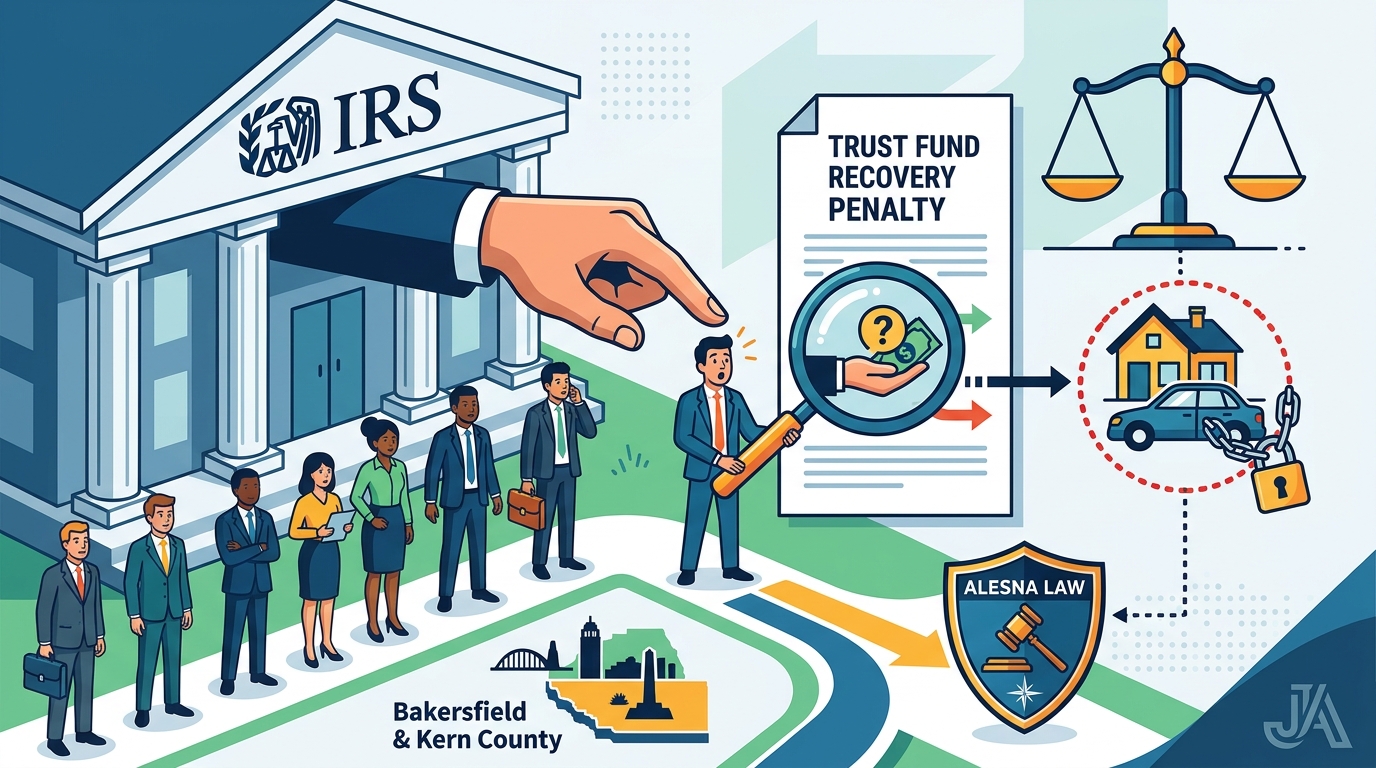
When a business fails to pay withheld payroll taxes, the IRS may hold specific individuals personally liable. This designation, known as the Trust Fund Recovery Penalty, targets those with the authority to control funds and the willfulness to ignore payment obligations. The Law Office of Jorge Alesna, Jr. helps individuals in Bakersfield and Kern County understand these legal standards to protect their personal assets from corporate debt.
The Legal Standard for Personal Liability
The Trust Fund Recovery Penalty (TFRP) is a civil penalty that allows the IRS to collect unpaid trust fund taxes from individuals rather than the business entity. Under Internal Revenue Code Section 6672, the IRS must prove two distinct elements to impose this penalty. First, the individual must be a responsible person. Second, the individual must have acted willfully. Both elements are required for the penalty to be valid.
A responsible person is an individual who has the duty to collect, account for, and pay over trust fund taxes. This status is not determined by a job title alone. The IRS looks at the actual authority an individual holds over the company's financial affairs. If you had the power to direct the payment of company bills, you may be considered a responsible person, regardless of your official title.
Factors That Establish Authority
The IRS evaluates several factors to determine if you had sufficient authority to control the company's funds. These factors include the ability to sign checks, control bank accounts, and decide which creditors get paid. The agency also considers your role in hiring and firing employees and your involvement in signing tax returns. A person who signs tax returns or has access to the company's general ledger is often viewed as having significant control.
Corporate officers, shareholders, and directors are frequently investigated, but the IRS does not automatically penalize everyone in these roles. The key is actual control. For example, a shareholder who does not participate in daily operations or financial decisions may not be a responsible person. Conversely, an employee with a modest title who actually manages the payroll and bank accounts may be held liable. The Law Office of Jorge Alesna, Jr. reviews these specific operational details to assess exposure.
Understanding Willfulness in Tax Law
Willfulness is a critical component of the TFRP. In this context, willfulness means a conscious, voluntary act to prefer other creditors over the United States. It does not require intent to break the law or a desire to defraud the government. A person can act willfully if they knew the taxes were due and chose to pay other bills instead. Negligence or carelessness can also constitute willfulness if the individual failed to make a good-faith effort to pay the trust fund taxes.
The IRS often argues that a responsible person who pays rent, utilities, or vendor invoices while leaving payroll taxes unpaid acted willfully. This is a common point of contention in tax disputes. The distinction between a good-faith effort to pay all debts and a deliberate choice to ignore the IRS is often the deciding factor in these cases. Understanding this legal nuance is essential for building a defense.
The IRS Investigation Process
The IRS typically initiates a TFRP investigation by sending a letter to the business and specific individuals. This letter may request a meeting with a Revenue Officer to discuss the unpaid taxes. The Revenue Officer will interview the individual to determine their role in the company and their decision-making process regarding payments. These interviews are formal and recorded. Statements made during these meetings can be used as evidence in a later penalty assessment.
It is crucial to understand that the burden of proof shifts during this process. While the IRS must initially establish that the individual was a responsible person, the individual must then prove they did not act willfully. This is a high bar. Many individuals assume that because they did not intend to harm the company, they are safe. However, the law focuses on the outcome and the choices made, not just the intent. The Law Office of Jorge Alesna, Jr. prepares clients for these interviews to ensure their rights are protected.
Defending Against a TFRP Assessment
There are several strategies to challenge a TFRP assessment. One common defense is to show that the individual was not a responsible person. This involves demonstrating a lack of authority over financial decisions. Another strategy is to prove a lack of willfulness. This requires showing that the individual made a good-faith effort to pay the taxes or that they were unaware of the liability. In some cases, the individual may argue that the IRS failed to follow proper procedures in issuing the notice of penalty.
Timing is also a critical factor. The IRS must issue the notice of penalty within three years of the date the taxes were assessed. If the IRS misses this deadline, the penalty may be invalid. Additionally, the individual has 30 days from the date of the notice to request a conference with the IRS Appeals Office. This is an opportunity to present evidence and arguments without going to court. Failing to meet these deadlines can result in a final assessment that is difficult to overturn.
Key Takeaways
- The Trust Fund Recovery Penalty targets individuals, not just the business entity.
- Job title alone does not determine liability; actual control of funds is the key factor.
- Willfulness includes negligence and the choice to pay other creditors first.
- The IRS must prove both responsibility and willfulness to impose the penalty.
- Interviews with Revenue Officers are formal and can be used as evidence.
- There are strict deadlines for appealing a TFRP assessment.
- Good-faith efforts to pay taxes can be a defense against willfulness.
Frequently Asked Questions
Can a passive shareholder be held liable for payroll taxes?
Generally, no. A passive shareholder who does not participate in the management or financial decisions of the company is unlikely to be considered a responsible person. However, if the shareholder has the ability to sign checks or control bank accounts, they may be investigated.
Does the IRS automatically penalize all corporate officers?
No. The IRS does not automatically penalize all officers. They investigate individuals who had the authority to control the company's funds. The agency looks at actual duties and responsibilities, not just titles.
What is the difference between a responsible person and a willful act?
A responsible person is someone with the authority to pay taxes. A willful act is a conscious decision to not pay them. Both must be present for the penalty to apply. You can be a responsible person but not act willfully if you made a good-faith effort to pay.
How long does the IRS have to issue a TFRP notice?
The IRS must issue the notice of penalty within three years of the date the taxes were assessed. If this deadline is missed, the penalty may be invalid. This is a common procedural defense in tax disputes.
Can I appeal a TFRP assessment?
Yes. You have 30 days from the date of the notice to request a conference with the IRS Appeals Office. This is an administrative appeal that allows you to present evidence and arguments. If the appeal is unsuccessful, you may have other legal options.
Protecting Your Personal Assets
Facing a TFRP investigation is a serious matter that can impact your personal finances. The Law Office of Jorge Alesna, Jr. provides experienced representation for individuals in Bakersfield and Kern County dealing with IRS payroll tax issues. We help you understand the legal standards and develop a strategy to protect your assets. If you have received a letter from the IRS regarding unpaid payroll taxes, contact our office to discuss your options.