
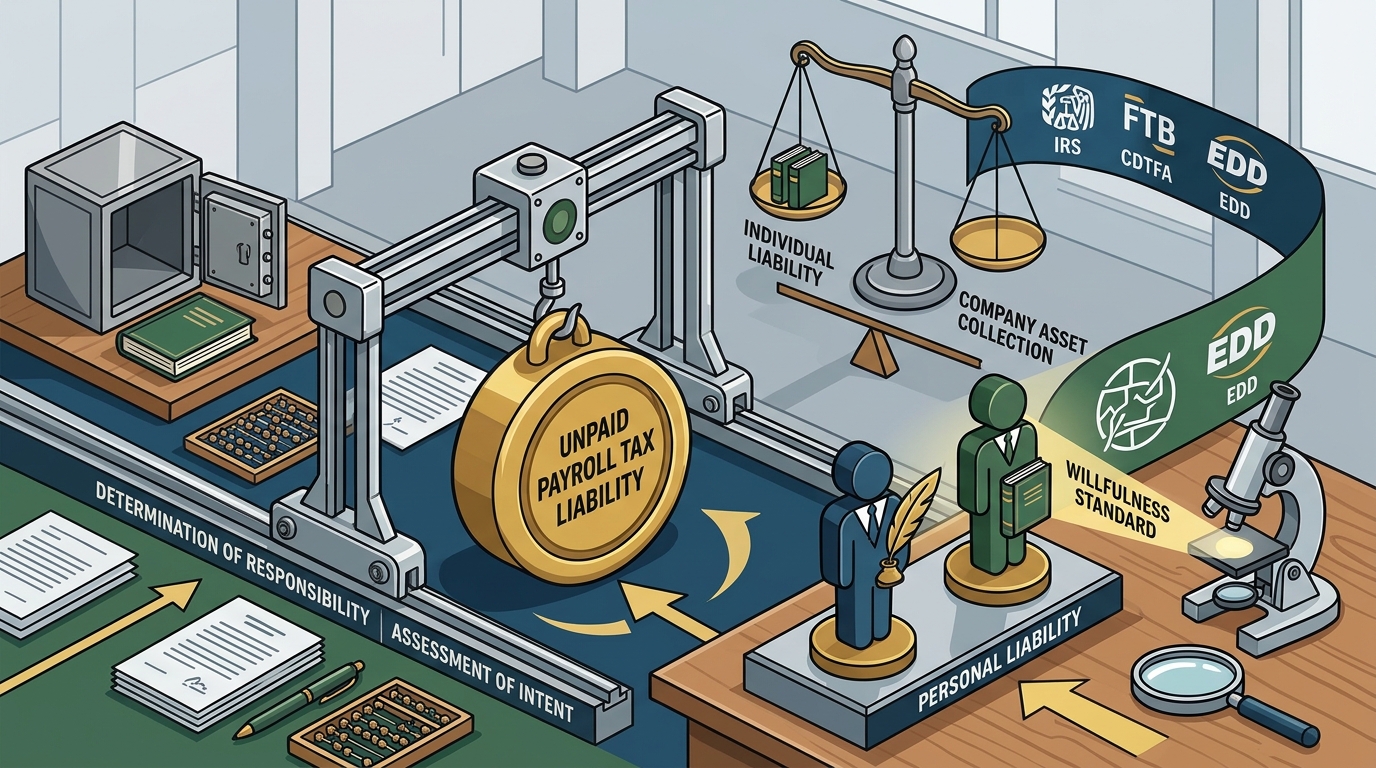
Responsible person assessment is a legal mechanism that shifts a business's unpaid payroll tax debt to specific individuals who had authority over the company's finances. The Law Office of Jorge Alesna, Jr. explains how this process works, focusing on the willfulness standard, the determination of responsibility, and the assessment of intent. This guide covers the critical legal thresholds that define personal liability for employment taxes.
The Willfulness Standard
Willfulness is the mental state required for the government to hold an individual personally liable for a company's unpaid payroll taxes. It is not a simple mistake or a good-faith error. The law requires a specific type of intent that goes beyond negligence. Understanding this standard is the first step in evaluating any personal liability claim.
Defining Willful Failure
Willful failure is a conscious, intentional, and voluntary act to prefer other creditors over the government. It is not a passive omission. The individual must have known that the taxes were due and chosen not to pay them. This standard protects individuals who made honest mistakes or who were unaware of the tax obligations.
Knowledge and Intent
The government must prove that the individual knew the taxes were owed. This knowledge can be direct or inferred from the person's role and actions. Intent is shown by the person's behavior, such as paying other bills while ignoring tax deposits. The burden of proof is high, but it is not impossible to meet.
Common Misconceptions
Many business owners believe that being an officer makes them automatically liable. This is incorrect. Liability depends on specific actions and mental states. A title alone does not create willfulness. The focus is always on what the person actually did and knew at the time.
Responsible Person Determination
Responsible person determination is the process of identifying which individuals had the authority to control the company's financial affairs. It is a factual inquiry that looks at the person's actual role, not just their job title. This determination is the foundation of any personal liability assessment.
Authority and Control
Authority is the power to make decisions about the company's money. Control is the ability to execute those decisions. A responsible person must have both. This can include signing checks, managing bank accounts, or approving payments. The scope of this authority is critical to the analysis.
Job Title vs. Actual Role
A job title is a starting point, but it is not the final answer. The law looks at the actual duties performed. A person with a modest title may be a responsible person if they had significant financial control. Conversely, a high-ranking officer may not be liable if they had no real authority over tax payments. The facts of the working relationship are paramount.
Factors Considered
Several factors help determine responsibility. These include the person's role in hiring and firing, their ability to sign checks, their control over bank accounts, and their involvement in tax filings. The analysis is holistic. No single factor is dispositive. The overall picture of the person's influence on the company's finances is what matters.
Willfulness Assessment
Willfulness assessment is the evaluation of the individual's mental state at the time the taxes went unpaid. It is a subjective inquiry that looks at the person's knowledge and intent. This assessment is often the most contested part of a liability case. It requires a detailed review of the person's actions and the circumstances surrounding the non-payment.
Evidence of Willfulness
Evidence of willfulness can include financial records, bank statements, and testimony. The government looks for patterns of behavior that show a deliberate choice to not pay taxes. This might include paying personal expenses or other business debts while ignoring tax obligations. The evidence must be clear and convincing.
Good Faith and Mistake
A good-faith mistake is not willful. If an individual reasonably believed the taxes were paid or that they were not responsible, they may not be liable. This is a critical defense. The assessment must distinguish between a deliberate act and an honest error. The context of the business's financial situation is also important.
Impact on Liability
The result of the willfulness assessment determines whether personal liability attaches. If willfulness is proven, the individual is personally responsible for the trust fund portion of the unpaid taxes. This liability is separate from the business's debt. It can have significant financial consequences for the individual. The assessment is a critical step in the legal process.
Comparison of Liability Standards
| Standard | Definition | Key Requirement | Outcome |
|---|---|---|---|
| Willfulness | Conscious and intentional failure to pay | Knowledge and intent | Personal liability |
| Responsible Person | Individual with authority over finances | Actual control and authority | Subject to assessment |
| Good Faith | Honest mistake or lack of knowledge | Reasonable belief | No personal liability |
Key Takeaways
- Willfulness is a conscious and intentional act, not a mistake.
- Responsible person status depends on actual authority, not just job title.
- The government must prove both responsibility and willfulness.
- Good-faith errors are not willful and do not create personal liability.
- Financial records and behavior are key evidence in willfulness assessments.
- Personal liability is separate from the business's tax debt.
- Legal representation is essential for navigating these complex determinations.
- Early intervention can help protect personal assets and clarify liability.
Frequently Asked Questions
What is a responsible person assessment?
A responsible person assessment is a legal process that holds an individual personally liable for a business's unpaid payroll taxes. It requires proof that the person had authority over the company's finances and willfully failed to pay the taxes.
Does being an officer make me personally liable?
No, being an officer does not automatically make you personally liable. Liability depends on your actual authority and control over the company's financial affairs, as well as your willful intent to not pay the taxes.
What is the willfulness standard?
The willfulness standard requires a conscious, intentional, and voluntary act to prefer other creditors over the government. It is not a passive omission or a good-faith mistake.
How is responsible person status determined?
Responsible person status is determined by looking at the individual's actual role, authority, and control over the company's finances. Job title is a starting point, but the actual duties performed are the most important factor.
Can I be liable if I made a mistake?
If you made a good-faith mistake and reasonably believed the taxes were paid or that you were not responsible, you may not be liable. Willfulness requires a deliberate act, not an honest error.
What evidence is used to prove willfulness?
Evidence of willfulness can include financial records, bank statements, and testimony. The government looks for patterns of behavior that show a deliberate choice to not pay taxes, such as paying other debts while ignoring tax obligations.
What are the consequences of personal liability?
Personal liability means you are personally responsible for the trust fund portion of the unpaid taxes. This liability is separate from the business's debt and can have significant financial consequences for you.
How can I protect myself from personal liability?
You can protect yourself by ensuring that taxes are paid on time, by documenting your role and authority, and by seeking legal advice if you are facing a liability assessment. Early intervention is key.Conclusion
Responsible person assessment is a serious legal matter that can have significant financial consequences for business owners and officers. Understanding the willfulness standard and the responsible person determination is essential for protecting your personal assets. The Law Office of Jorge Alesna, Jr. provides experienced guidance for individuals and businesses facing these complex tax disputes. If you are concerned about personal liability for unpaid payroll taxes, for a confidential consultation.