
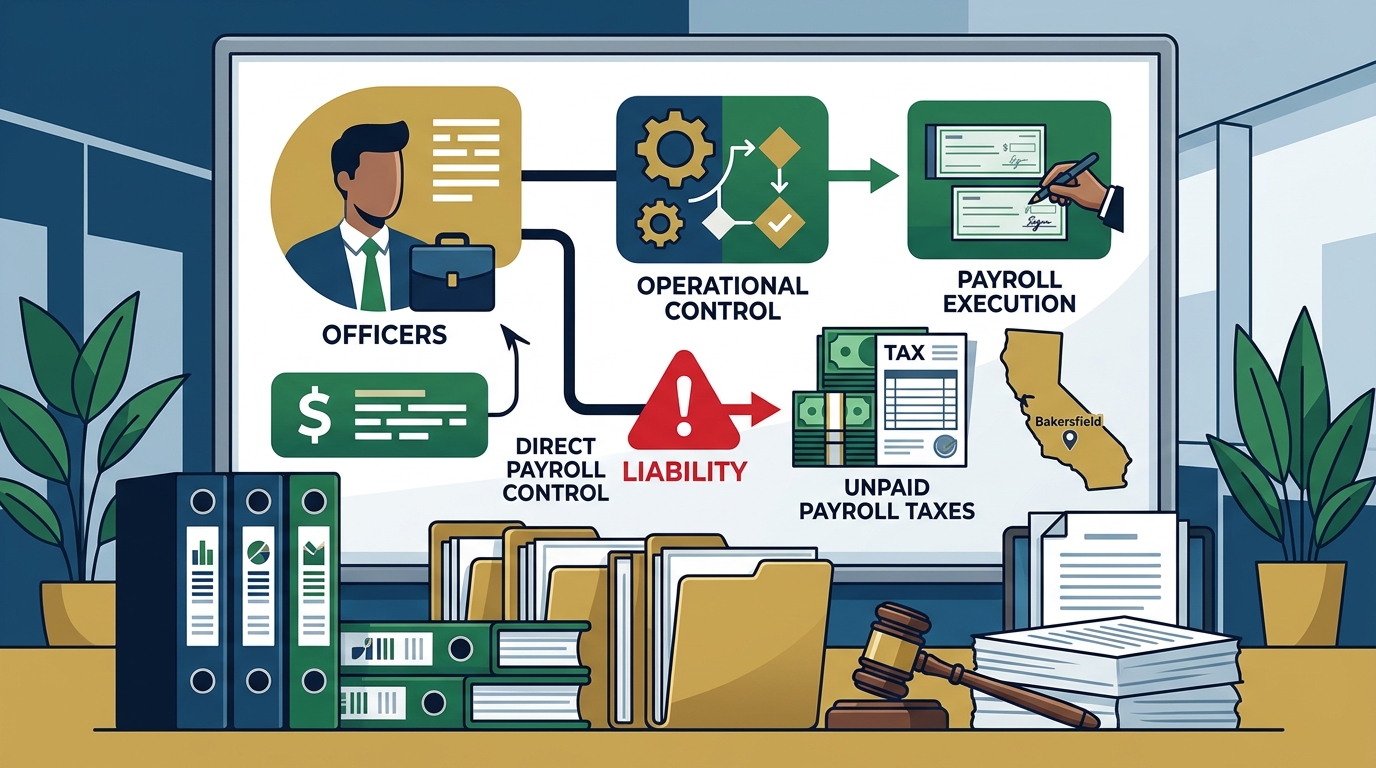
Officers face personal liability for unpaid payroll taxes even when they do not directly control payroll decisions. The IRS and California agencies look at broader operational control, not just who signs checks. This guide explains the legal standards, key factors, and defenses available to business leaders in Bakersfield and across California. according to 5 17 7
Operational Control Requirements
Personal liability for unpaid payroll taxes is not limited to the person who physically processes payroll. The legal standard focuses on whether an officer had the authority to control the payment of creditors, including the government. This concept is often referred to as "responsible person" status in federal law and similar standards in California state law.
The Federal Responsible Person Standard
Under federal law, the IRS can assess the Trust Fund Recovery Penalty (TFRP) against any individual who was responsible for collecting, accounting for, and paying over trust fund taxes and who willfully failed to do so. The IRS does not require that the officer actually performed the payroll duties. Instead, it looks at whether the officer had the power to direct the company's financial decisions. If an officer had the authority to decide which bills were paid, they may be held personally liable, even if they delegated the actual payroll processing to a bookkeeper or CFO.
California State Standards
California agencies, such as the Employment Development Department (EDD) and the Franchise Tax Board (FTB), apply similar principles. The EDD can pursue personal liability for unpaid employment taxes under the Unemployment Insurance Code. The key question is whether the individual had the authority to control the payment of the company's debts. In many cases, this means looking at the officer's role in the corporate structure, their involvement in financial management, and their ability to influence the company's cash flow.
It is a common misconception that only the payroll manager or the person who signs the checks is liable. In reality, the law casts a wider net. An officer who has significant influence over the company's finances, even without direct payroll control, can be deemed a responsible person. This is why the distinction between "operational control" and "payroll control" is critical. Operational control refers to the broader authority to manage the company's resources, while payroll control is a specific subset of that authority.
Operational Control Factors
When determining if an officer is personally liable, agencies examine a variety of factors to assess the level of operational control. These factors help establish whether the officer had the authority to direct the company's financial decisions, including the payment of taxes.
Authority to Determine Creditors
One of the most significant factors is whether the officer had the authority to determine which creditors would be paid. This includes the ability to decide if the company would pay its tax liabilities or prioritize other expenses, such as vendor invoices or loan payments. If an officer had the power to approve or reject payments to the government, they are likely to be considered a responsible person. The IRS and state agencies often look at bank signatures, approval thresholds, and the officer's involvement in financial meetings to determine this authority.
Control Over Payroll Disbursements
Another key factor is the officer's control over payroll disbursements. This does not necessarily mean the officer processed the payroll. It means they had the authority to approve the payroll, ensure that funds were available, and direct how the money was distributed. If an officer could stop or delay payroll payments to prioritize other expenses, they may be held liable. The agencies look at the officer's ability to influence the timing and amount of payroll payments, as well as their involvement in setting employee wages and benefits.
Other Indicators of Control
Agencies also consider other indicators of operational control, such as the officer's title, their role in the company's bylaws, and their involvement in major financial decisions. For example, a CEO or President who has final say over the company's budget is likely to be considered a responsible person, even if they do not handle payroll. Similarly, an officer who has the authority to sign checks, open bank accounts, or approve large expenditures may be held liable. The goal is to identify individuals who had the power to ensure that taxes were paid, regardless of whether they actually performed the task.
| Factor | Description | Relevance to Liability |
|---|---|---|
| Authority to Determine Creditors | Power to decide which bills are paid, including taxes | High: Directly indicates control over tax payments |
| Control Over Payroll Disbursements | Authority to approve or delay payroll payments | High: Shows ability to influence tax withholding |
| Bank Signatures | Ability to sign checks or authorize transfers | Medium: Indicates financial authority |
| Corporate Title | Role such as CEO, President, or CFO | Medium: Suggests high level of control |
| Involvement in Financial Decisions | Participation in budgeting and cash flow management | High: Demonstrates operational control |
Understanding these factors is essential for business owners and officers who want to protect themselves from personal liability. It is not enough to simply delegate payroll duties. Officers must be aware of their broader financial responsibilities and the potential consequences of failing to ensure that taxes are paid. If you are facing a personal liability assessment, it is important to review your role in the company and the evidence that agencies may use to establish your control.
Key Takeaways
- Personal liability for payroll taxes is based on operational control, not just payroll processing. according to Understanding Your Personal
- The IRS and California agencies look at the authority to determine which creditors are paid.
- Officers with the power to approve or delay payments may be held liable, even if they do not handle payroll.
- Bank signatures, corporate titles, and involvement in financial decisions are key factors in determining liability.
- Delegating payroll duties does not eliminate personal liability if the officer retains operational control.
- Understanding the legal standards for responsible person status is critical for protecting personal assets.
- Consulting with a tax attorney can help clarify your liability and develop a defense strategy.
Frequently Asked Questions
Do I have to sign payroll checks to be personally liable?
No. You do not need to physically sign payroll checks to be held personally liable. The key is whether you had the authority to control the payment of the company's debts, including taxes. If you had the power to direct which creditors were paid, you may be considered a responsible person.
Can a CEO be held liable if they delegate payroll to a CFO?
Yes. A CEO can be held personally liable if they had the authority to control the company's financial decisions, even if they delegated the actual payroll processing to a CFO. The law looks at the broader operational control, not just the specific task of processing payroll.
What is the difference between operational control and payroll control?
Operational control refers to the broader authority to manage the company's resources and financial decisions. Payroll control is a specific subset of that authority, involving the processing and payment of employee wages. Personal liability is based on operational control, which includes the ability to direct the payment of taxes. according to 5 17 7
How does the IRS determine if I am a responsible person?
The IRS examines factors such as your authority to determine which creditors are paid, your control over payroll disbursements, your bank signatures, and your involvement in financial decisions. They look at the overall picture to determine if you had the power to ensure that taxes were paid.
Can I avoid personal liability by not being involved in finances?
It is difficult to avoid personal liability if you hold a significant position in the company. Even if you do not actively manage finances, your title and role may indicate that you had the authority to control the company's resources. The agencies will look at your actual involvement, but your position alone can be a factor.
What should I do if I receive a personal liability assessment?
If you receive a personal liability assessment, it is important to consult with a tax attorney. They can help you review the evidence, determine if you were truly a responsible person, and develop a defense strategy. Do not ignore the assessment, as it can lead to further collection actions.
Conclusion
Officers in Bakersfield and across California must understand that personal liability for payroll taxes is not limited to those who directly process payroll. The legal standard focuses on operational control, which includes the authority to determine which creditors are paid and the ability to influence the company's financial decisions. If you are facing a personal liability assessment, it is important to review your role in the company and the evidence that agencies may use to establish your control. The Law Office of Jorge Alesna, Jr. provides experienced representation for individuals and businesses facing these complex tax disputes. To discuss your situation, for a confidential review.