
Choosing the Right Sales Tax Attorney for a CDTFA Audit
When the California Department of Tax and Fee Administration (CDTFA) opens a sales tax audit, the stakes extend far beyond a simple accounting discrepancy. A CDTFA audit is a structured enforcement action that can result in significant assessments, penalties, and interest. The Law Office of Jorge Alesna, Jr. provides direct, attorney-led representation for businesses in Bakersfield and across California facing these complex disputes. This guide explains the audit process, the legal strategies used in sales tax defense, and the specific criteria for selecting qualified legal counsel.
CDTFA Audit Representation
A CDTFA audit is an examination of a business's financial records to determine whether it has reported the correct amount of taxes or fees. California businesses that sell taxable goods, collect sales tax, or owe use tax can be subject to audit. The process is not a casual check of recent filings. It is a structured review built around assumptions, estimates, and ratios used to test the accuracy of what a business reported. Auditors weigh whether reported figures line up with the business's actual activities. CDTFA Publication 76 states that auditors will impartially determine whether you have reported the correct amount of taxes or fees, and that overpayments as well as underpayments are considered. That means an audit can uncover a refund position, although the practical focus is often on underreported liabilities.
Understanding the Audit Triggers
CDTFA audits are rarely random. In many cases, they are shaped by automated comparisons between what a business reports and what third-party data shows. When those numbers do not align, the agency can open an audit. Several other factors can also draw attention. Sources that track California sales tax audit activity point to data analytics, industry targeting, referrals, and random selection as possible triggers. The agency often runs targeted examinations by industry, so businesses in certain sectors may face a higher risk of review than others. Audits are highly targeted and often industry-specific, and auditors use a wide range of methods to test reported figures.
The Role of Legal Counsel
While there is no such requirement for most CDTFA taxes and fees, it is recommended that you select a qualified tax professional when you need help with the preparation of returns or for assistance with audits or appeals. CDTFA recommends selecting a qualified tax professional for assistance with audits. For a business facing a CDTFA audit, having legal representation can be a significant advantage. An attorney can help you understand the proposed tax, challenge unsupported assumptions, and protect your appeal rights before a deadline closes off an option. The Law Office of Jorge Alesna, Jr. represents businesses in CDTFA sales and use tax audits and administrative appeals throughout California, with a particular focus on businesses in Bakersfield, Kern County, and the Central Valley.
Sales Tax Defense Strategies
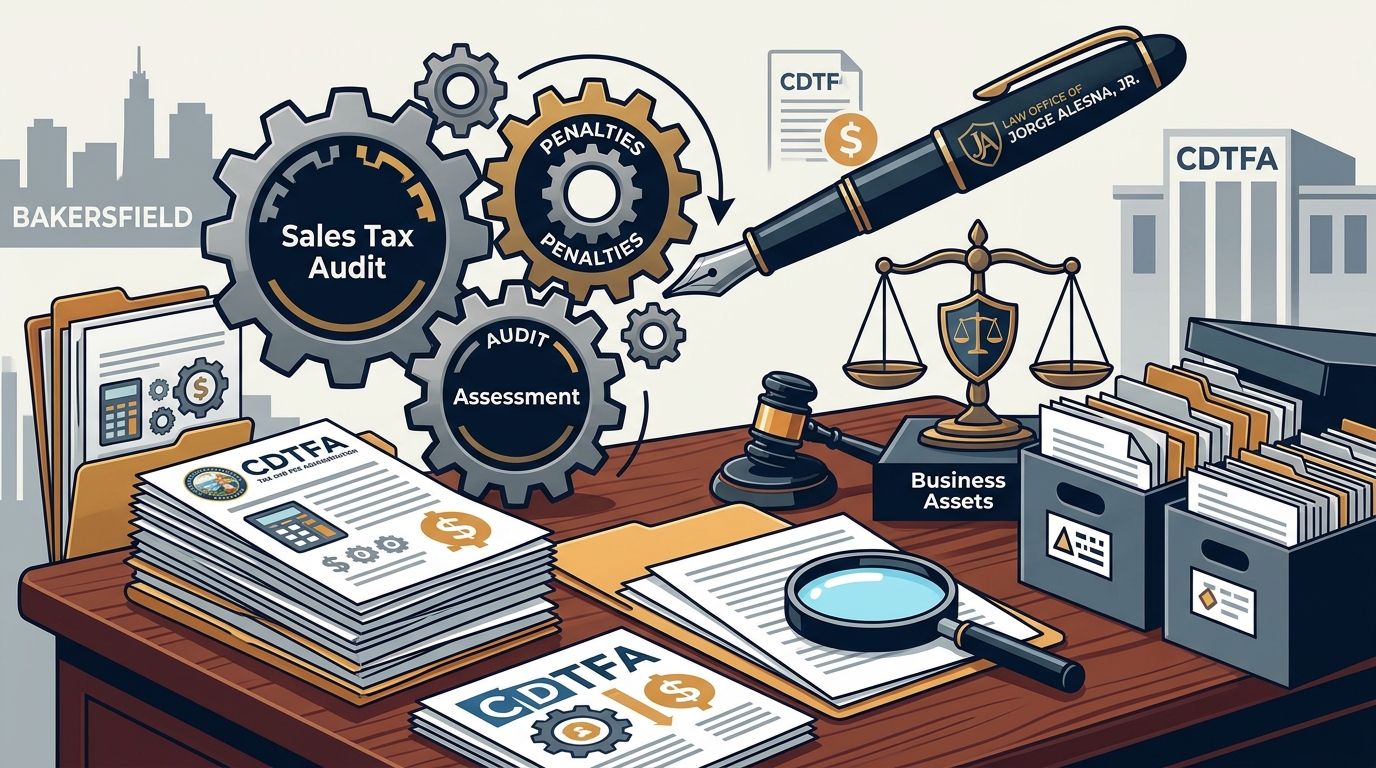
Sales tax defense is the legal process of challenging a CDTFA assessment or audit finding. A sales tax audit is more than an accounting exercise. The methodology the CDTFA uses can have an enormous impact on the final assessment. CDTFA auditors may examine sales tax returns, federal and state income tax returns, bank statements and deposits, credit card and merchant processor records, point-of-sale reports, general ledgers, sales journals, purchase invoices, resale certificates, exemption certificates, inventory records, cash sales, vendor records, and business records from third parties. When the records are incomplete or the CDTFA believes reported sales are unreliable, the auditor may use an indirect audit method to estimate taxable sales. That is often where significant disputes arise.
Challenging Audit Methodologies
An estimate based on bank deposits, credit card ratios, purchase markups, observation tests, or other sampling methods can produce a tax assessment substantially higher than the business's actual taxable sales. An audit methodology is not necessarily correct simply because the CDTFA used it. One of the most important parts of defending a sales tax audit is understanding exactly how the auditor calculated the alleged understatement. The Law Office of Jorge Alesna, Jr. examines the CDTFA's audit schedules and supporting workpapers rather than simply accepting the bottom-line assessment. Depending on the case, issues may include incorrectly treating nontaxable deposits as sales, including loans, transfers, or capital contributions in gross receipts, double-counting transactions, or incorrect application of exemption certificates.
Field Billing Orders and Determinations
A field billing order, often called an FBO, is a procedure CDTFA uses to recommend additional tax or a refund outside a regular audit. CDTFA's Audit Manual explains that an FBO is not an audit report and does not change the account's audit status. CDTFA may use an FBO for a specific transaction, an isolated reporting error, an unreported use tax purchase, or a refund issue that does not require a full audit. It can also use one to recommend an estimated billing for a period approaching the assessment deadline. The practical point is that a full audit does not have to be completed before CDTFA moves toward a bill. Ask what transaction, period, and evidence support the proposed adjustment. Then watch for the formal Notice of Determination. That notice is the document that triggers the right to appeal. For more information on how these processes interact, see the Bakersfield Sales Tax Attorney guide.
Attorney Selection Criteria
Selecting the right sales tax attorney for a CDTFA audit requires careful consideration of several factors. The attorney you choose will represent your business in a high-stakes dispute with a state agency. The wrong choice can lead to missed deadlines, weak arguments, and unfavorable outcomes. The right choice can protect your business's assets, reduce or eliminate the assessment, and provide a clear path to resolution. When evaluating potential counsel, consider the following criteria.
Experience with CDTFA Matters
Not all tax attorneys have experience with CDTFA audits. Some may focus primarily on federal IRS matters or on tax preparation. CDTFA audits involve specific California statutes, regulations, and administrative procedures. An attorney who has handled CDTFA sales and use tax audits will understand the agency's methodologies, its internal guidelines, and the nuances of California sales tax law. The Law Office of Jorge Alesna, Jr. focuses exclusively on tax controversy, including audits, appeals, and collection matters involving income tax, payroll tax, and sales and use tax. This focused practice allows for deep expertise in the specific issues that arise in CDTFA disputes.
Direct Attorney Involvement
When you hire a law firm, it is important to know who will actually handle your case. In some firms, you may speak with a paralegal or an associate, while the senior attorney oversees the matter from a distance. In other firms, the attorney you meet with is the one who will prepare your filings, communicate with the agency, and represent you at hearings. At the Law Office of Jorge Alesna, Jr., every matter is personally handled by Jorge Alesna, Jr., Attorney at Law. You speak directly with the attorney who is responsible for your case. This direct involvement ensures that your case receives the attention it deserves and that your concerns are addressed promptly and thoroughly.
Communication and Transparency
A good tax attorney should communicate clearly and frequently. You should understand what is happening with your case, what the next steps are, and what your options are. The attorney should explain complex legal concepts in plain language and should not use jargon to obscure the facts. The Law Office of Jorge Alesna, Jr. is committed to clear communication and transparency. The attorney takes the time to understand your situation, explain your options, and give you straight answers. Tax problems are difficult enough without feeling ignored or pressured. If you are facing a CDTFA audit, you need an attorney who will stand between you and the government, protect your rights, and help you move forward.
Comparison of Representation Options
| Representation Type | Typical Scope | Best For | Limitations |
|---|---|---|---|
| In-House Accountant | Record organization, basic responses | Simple audits with clear records | No legal authority, cannot challenge methodology |
| Tax Preparer | Return preparation, basic compliance | Routine filings, no dispute | Not qualified for legal representation in audits |
| Tax Attorney | Full legal representation, appeals, litigation | Complex audits, disputes, collections | Higher cost, requires legal expertise |
Key Takeaways
- A CDTFA audit is a structured enforcement action that can result in significant assessments, penalties, and interest.
- CDTFA audits are often triggered by data analytics, industry targeting, or discrepancies between reported and third-party data.
- CDTFA recommends selecting a qualified tax professional for assistance with audits and appeals.
- Sales tax defense involves challenging the CDTFA's audit methodology, not just the bottom-line assessment.
- Field billing orders can lead to bills without a full audit, so it is important to understand the proposed adjustment.
- When selecting an attorney, look for specific experience with CDTFA sales and use tax audits.
- Direct attorney involvement ensures that your case receives the attention it deserves.
- Clear communication and transparency are essential in a high-stakes tax dispute.
Frequently Asked Questions
What is a CDTFA audit?
A CDTFA audit is an examination of a business's financial records to determine whether it has reported the correct amount of taxes or fees. It is a structured enforcement action built around assumptions, estimates, and ratios used to test the accuracy of what a business reported.
Do I need a lawyer for a CDTFA audit?
While there is no legal requirement to hire a lawyer for a CDTFA audit, it is recommended that you select a qualified tax professional for assistance with audits and appeals. A lawyer can help you understand the proposed tax, challenge unsupported assumptions, and protect your appeal rights.
What is a field billing order?
A field billing order, or FBO, is a procedure CDTFA uses to recommend additional tax or a refund outside a regular audit. It is not an audit report and does not change the account's audit status.
How can I challenge a CDTFA audit?
You can challenge a CDTFA audit by filing an administrative appeal. This involves presenting evidence and legal arguments to show that the CDTFA's assessment is incorrect. An attorney can help you build the strongest factual and legal case for reducing or eliminating the proposed liability.
What should I look for in a sales tax attorney?
Can a CDTFA audit result in a refund?
Yes. CDTFA Publication 76 states that auditors will impartially determine whether you have reported the correct amount of taxes or fees, and that overpayments as well as underpayments are considered. That means an audit can uncover a refund position.
Conclusion
Facing a CDTFA audit is a serious matter that requires careful and strategic handling. The audit process is complex, and the stakes are high. By understanding the audit process, the legal strategies available for sales tax defense, and the criteria for selecting qualified legal counsel, you can make an informed decision about how to proceed. The Law Office of Jorge Alesna, Jr. is committed to providing clear, honest, and effective representation for businesses in Bakersfield and across California. If you are facing a CDTFA audit, to discuss your options.